Phlox Overview
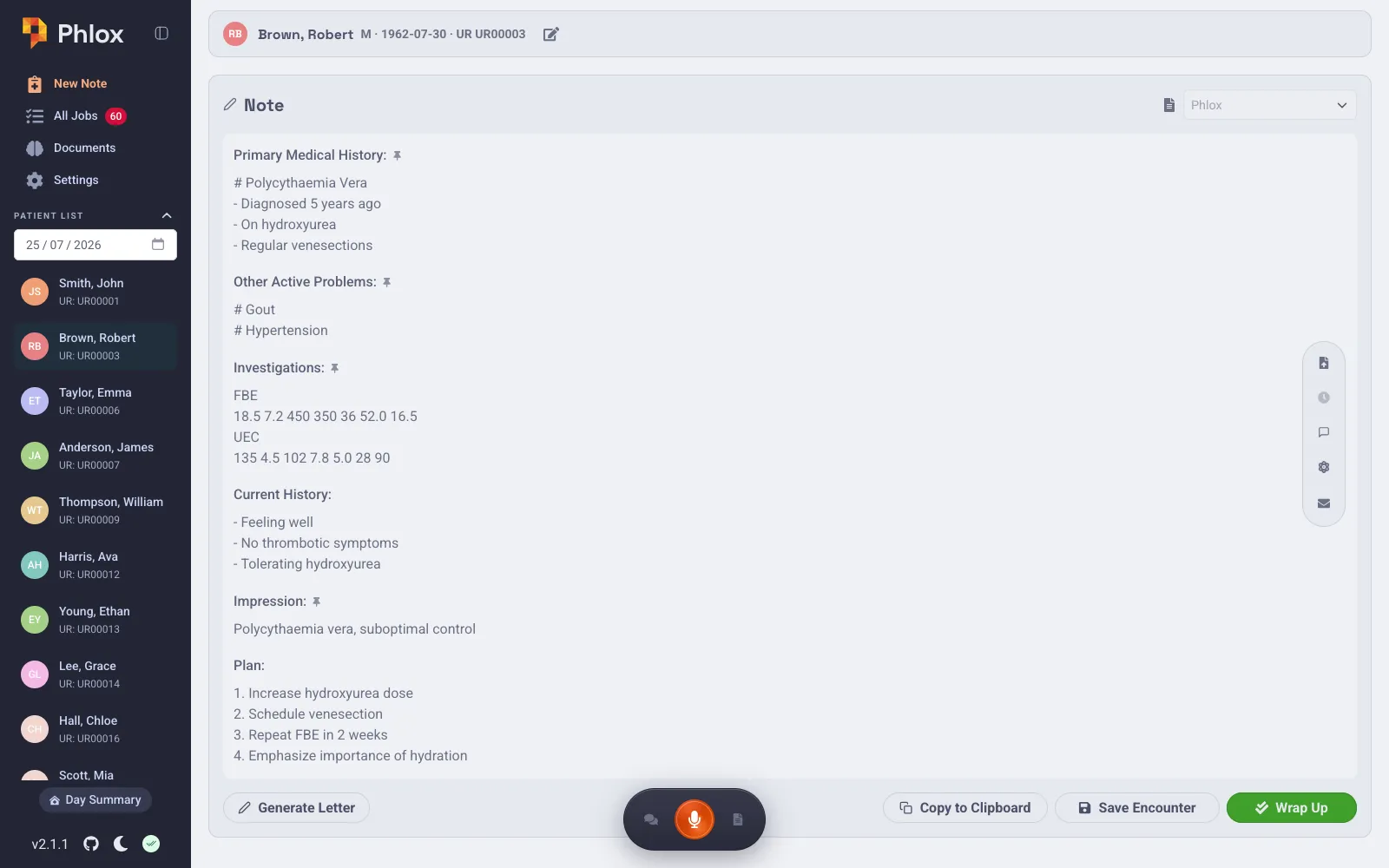
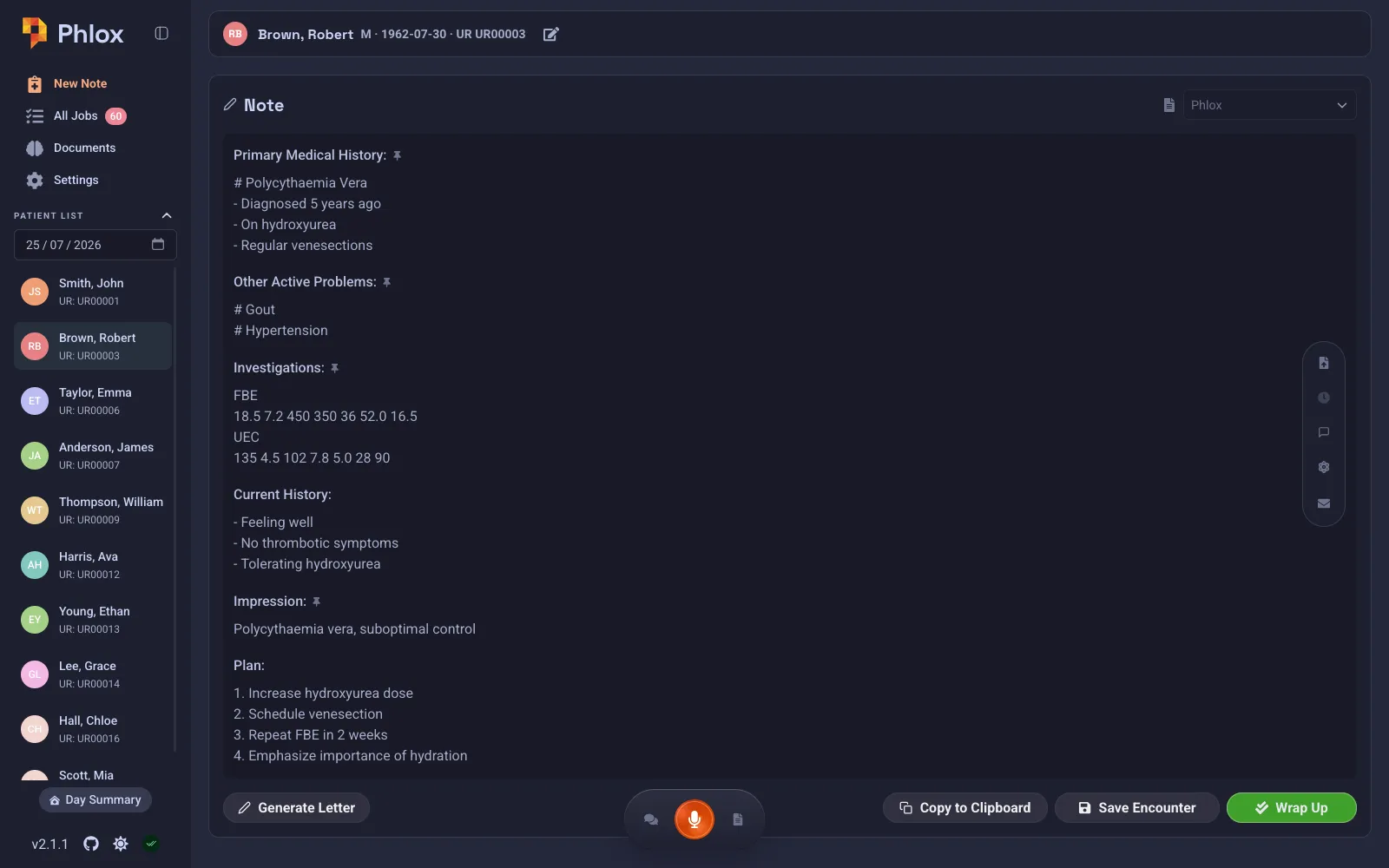
Welcome to the Phlox documentation. Phlox is a free, open-source, local-first AI scribe with a built-in patient management system and agentic AI capabilities. It is designed as a local alternative to SaaS medical scribes that you can run on your own hardware.
Before using Phlox, read Limitations & Warnings. Phlox is experimental, is not a certified medical device, and is not suitable for production clinical use as provided.
What is Phlox?
Phlox is a local-first clinical tool with the following capabilities:
- Patient Profiles & Encounters — stable demographics per patient, with individual encounter notes, transcripts, and tasks grouped by UR number. See Patients.
- Multi-User Accounts — username/password login with admin and clinician roles; each user's encounters, letters, templates, and knowledge base stay their own. See Users & Authentication.
- Ambient Medical Transcription — record or upload audio; Phlox transcribes it and generates a structured note from your chosen template. Uses Whisper-compatible endpoints or the bundled parakeet.cpp engine. See Transcription.
- Live Agent — a real-time scribe that drafts the note while the consultation happens, acts on spoken requests (letters, PDF forms, calculations), and takes voice commands during wrap-up. See Live Agent.
- Multilingual — transcribe and generate notes, letters, and chat in your language, with the preferred language set per user. Desktop offers a downloadable multilingual transcription model; remote endpoints support any language. See Language Support.
- Adaptive Refinement — Phlox learns from the edits you make to generated notes and adapts future output to your style. See AI Features → Adaptive Refinement.
- Flexible Templates — customisable note and letter templates with per-field prompts, formatting rules, and persistence. Generate templates automatically from an example note. See Templates.
- Task Manager — action items are extracted from the Plan section of notes and tracked per patient; plus a separate workspace to-do list. See Task Manager.
- Correspondence — one-click generation of patient letters from a note or from dictation, with interactive refinement. See Correspondence.
- PDF Form Filling — draw fields on a PDF template (or auto-detect them with vision) and have the AI fill them from encounter data. See PDF Forms.
- Agentic AI Assistant — chat with built-in tools (note/transcript/literature search, task management, form filling, and more), interleaved thinking, inline citations, and downloadable artifacts. See AI Features.
- Knowledge Base — build a local, searchable corpus of reference literature (guidelines, journals) and have chat answer with inline citations. See Knowledge Base.
- Agent Dashboard — a chat-driven hub for clinic management with a to-do panel, specialty-aware suggestions, and document upload. See Agent Dashboard.
- MCP Server Support — connect external tool servers via the Model Context Protocol (SSE transport), with optional PHI filtering. See Settings → Tools.
- Vision-Enhanced Document Processing — hybrid pipeline that uses vision models directly when available, falling back to text extraction and OCR.
- 100% Local & Private — runs on your own machine or server; all data stays under your control. Optional local LLM (bundled llama.cpp), transcription (bundled parakeet.cpp), and embedding (bundled Qwen3-Embedding) servers.
Design
- Runs locally on standard hardware (GPU or Apple Silicon strongly recommended).
- Customisable templates, prompts, and LLM settings.
- Clinical data is encrypted at rest with SQLCipher (reference literature lives in a separate file — see Security).
- Extensible via MCP server integration for custom tools and agentic workflows.
Philosophy
The core idea is to use LLMs to automate administrative tasks by:
- Surfacing relevant information from guidelines and journals
- Automating documentation tasks
- Organising and structuring clinical notes
- Providing an agentic chat interface that can take actions on your behalf (search notes, manage tasks, create encounters, fill forms)
Important Caveats
- LLMs can hallucinate plausible but incorrect information.
- Verification against primary medical sources is mandatory.
- Clinical judgment remains supreme; Phlox is an administrative aid, not a clinical decision-support tool.
- Models can misinterpret or omit important context.
- External MCP servers and external tools (PubMed, Wikipedia) may receive PHI depending on configuration — use the sensitive-data filtering toggle. See Security.
This is an experimental administrative tool designed to assist with documentation and reference, not to provide clinical decision support.